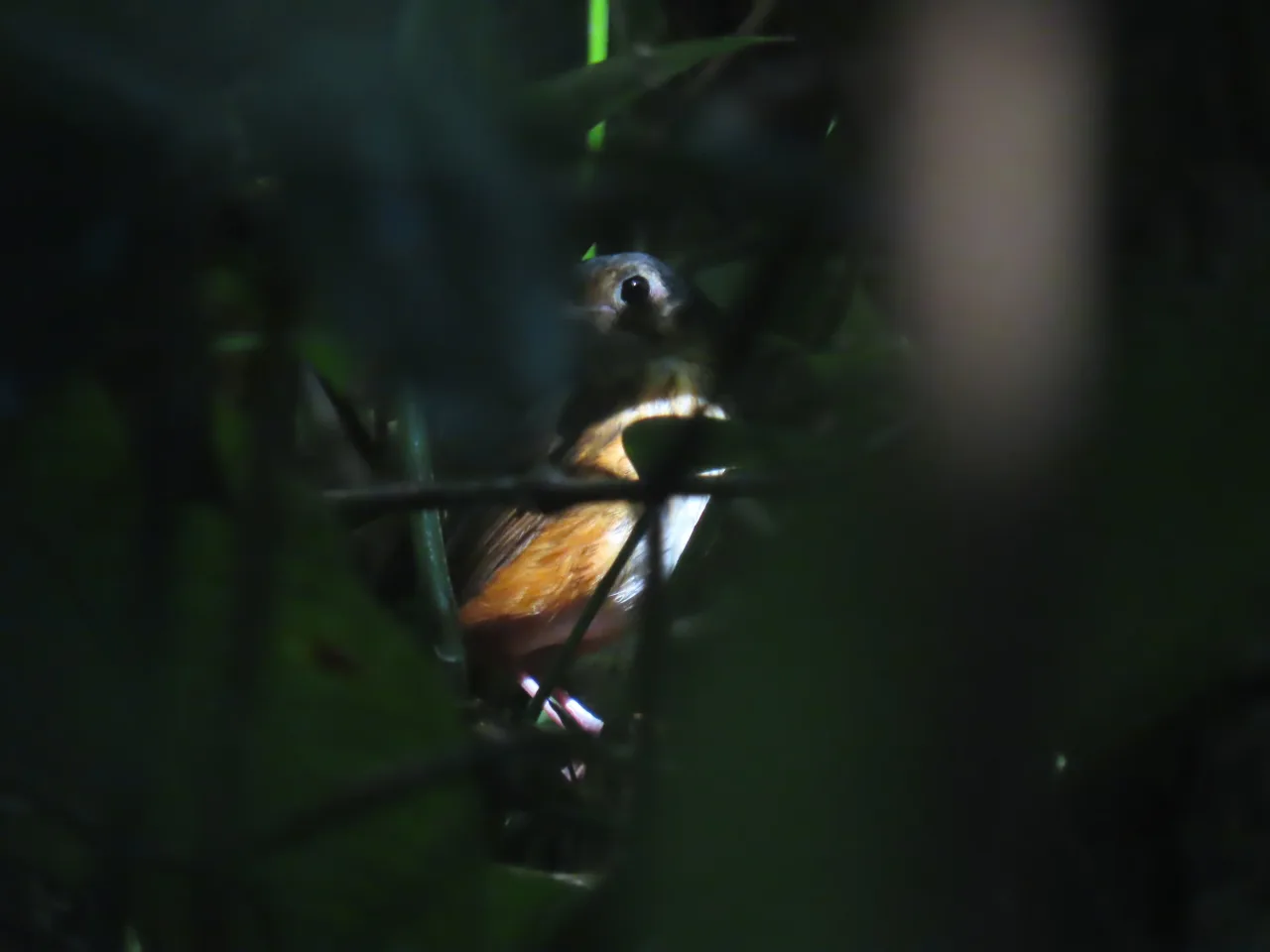
At La Mariola, I hear Thicket Antpitta (Myrmothera dives) almost every day. Its song can be heard around the cabins, beside the river, along trails, in the cacao area and at the vegetated edges where the forest becomes denser. It is one of those birds that seems to be everywhere, although seeing it is another matter.
I have gone out many times with my camera in search of a good photograph. Sometimes the song sounds close, almost within sight, but the bird remains tucked inside dense scrub among branches, leaves and shadows. The forest is dark, light enters in fragments, and while waiting you also have to contend with mosquitoes.
The best photograph I have managed came one morning while returning from El Castillo. I heard the bird relatively close, entered the forest and spent more than an hour trying to find an angle. The image is not perfect, but it tells the story of the encounter quite well: vegetation in front, little light, the body half hidden and just enough space to confirm it was there.
The experience matches descriptions of the species. Thicket Antpitta is secretive, very difficult to see and far easier to hear than to observe. Birds of the World also associates it with dense scrub, forest edges and tangled vegetation near streams or treefalls.
eBird shows that, in addition to my record, only five people in Nicaragua have uploaded images of this species. I do not mention this as proof of absolute rarity, but as an indication of what it takes to obtain a good image. Some birds are heard many times, but a photograph is another matter.
The photograph I have is enough to tell the story, but not to bring it to a close. I am still looking. Perhaps one day the light will fall more favorably, the bird will move just a few centimeters, and that presence that almost always arrives first through sound will finally be fully captured in a photograph.